Публикации

подготвени в изпълнение на проекта

Cultural diplomacy, UNESCO and the Balkans: achievements and challenges in the present time

Irina Bokova • Director-General of UNESCO (2009–2017)

In a world where political divisions, armed conflict, and global crises often dominate the headlines, culture remains one of humanity’s most enduring sources of unity and resilience. Cultural diplomacy is deeply entangled with terms such as cultural relations, soft power and public diplomacy and has emerged as one of the most vital and constructive tools in the international arena. When pursued in the spirit of openness and respect, it has the capacity to transcend borders, foster trust, and reaffirm our shared humanity.

The publication of the proceedings of the International Conference “Cultural Diplomacy and the Balkans: Achievements and Challenges in the Present Time” held in Sofia in October 2024 makes an important contribution to the debate about the role of soft power in international relations within certain historical context in the 20th and 21st century – from World War I to the present time, with a focus on the Balkans. It also makes a step forward to the new understanding of cultural diplomacy and its deep entanglement with terms such as cultural relations, soft power and public diplomacy.
Cultural diplomacy: the soft edges of hard power in the Balkans

Assist. Prof. Alexandra Milanova, PhD • Institute of Balkan Studies & Centre of Thracology, Bulgarian Academy of Sciences

The edited volume “Cultural Diplomacy and the Balkans: Achievements and Challenges in the Present Time” was being prepared at a time when significant armed conflicts were ongoing around the world, including the wars in Ukraine, Gaza and the civil war in Sudan. Simultaneously, the India-Pakistan crisis and the conflict between Israel and Iran were intensifying. Although some of these events developed far from the Balkans, in today’s increasingly globalized and interrelated world, no country or region can remain isolated. Consequences for one nation are consequences for us all. In this context, engaging in culture may seem rather insignificant. In view of the current geopolitical situation and interconnected global challenges confronting modern societies, leading topics remain economy, climate change, Generative AI, security and defence. Undoubtedly, they are all very important and have to be addressed properly. However, first we have to know what we are defending – because our last common good is culture.

This collection explores multiple cultural diplomacy expressions in the Balkans in the 20th and 21st centuries. It contains most of the contributions to the International Conference “Cultural Diplomacy and the Balkans: Achievements and Challenges in the Present Time” held in Sofia in October 2024.

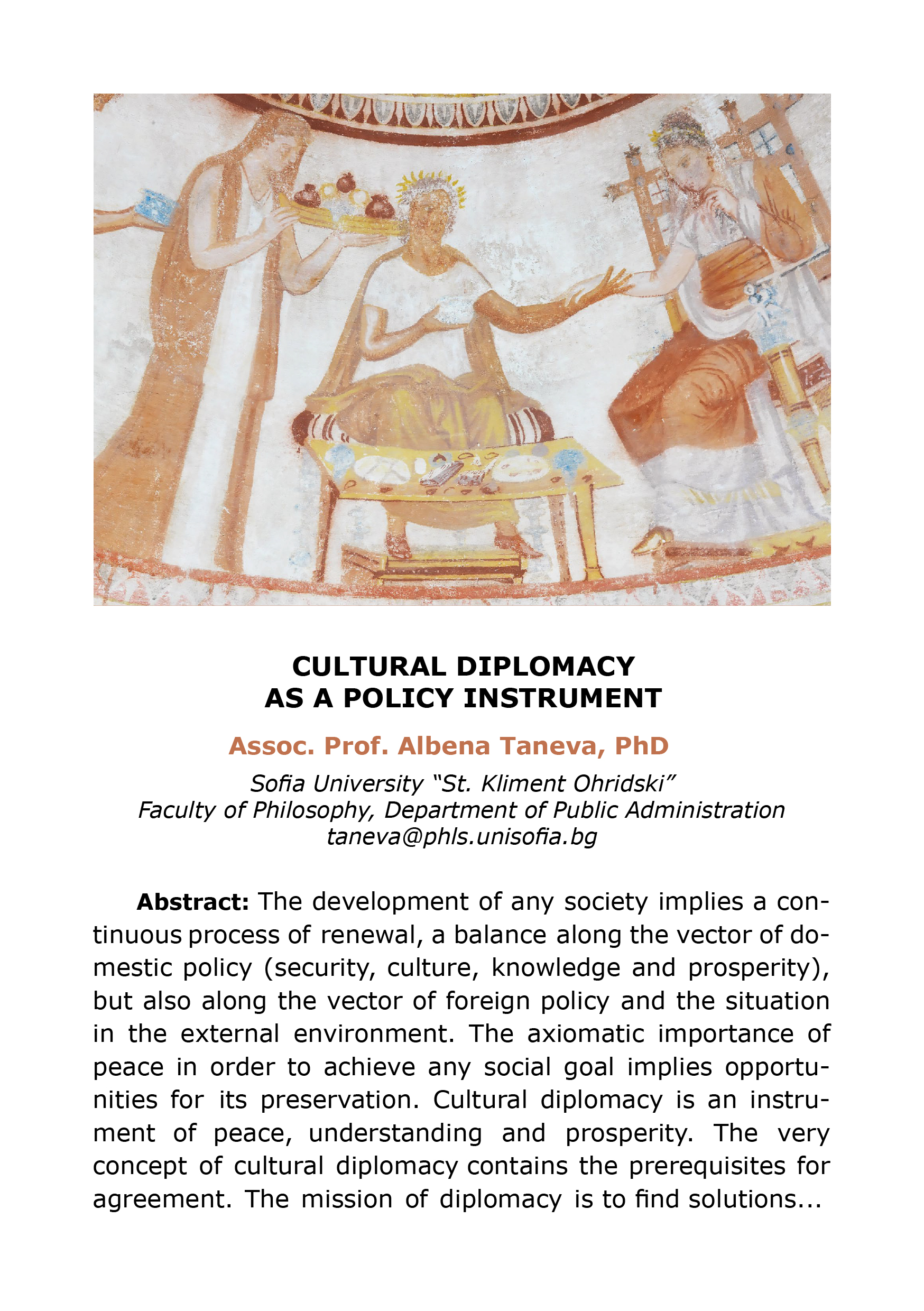
Cultural diplomacy as a policy instrument

Assoc. Prof. Albena Taneva, PhD • Sofia University "St. Kliment Ohridski", Faculty of Philosophy, Department of Public Administration

Abstract: The development of any society implies a continuous process of renewal, a balance along the vector of domestic policy (security, culture, knowledge and prosperity), but also along the vector of foreign policy and the situation in the external environment. The axiomatic importance of peace in order to achieve any social goal implies opportunities for its preservation. Cultural diplomacy is an instrument of peace, understanding and prosperity. The very concept of cultural diplomacy contains the prerequisites for agreement. The mission of diplomacy is to find solutions without – and regardless of – the presence of force and coercion. In every definition, culture implies a value base and integrity. Linking culture with diplomacy is one of the most goal-oriented, convincing and sustainable ways to achieve results in any area of public policy. This chapter conceptualizes cultural diplomacy as an independent reality, which creates prerequisites for understanding and sustainability in the international environment, but also acts as a tool catalysing cooperation, overcoming faults and prejudices, and creating prerequisites for social cohesion. This analysis uses a conceptual exhibition as a case study to explore cultural diplomacy as a policy tool, focusing on a specific historic al episode involving the fate of Jews in Bulgaria during the Holocaust and its role in contemporary memory policies. The conclusions highlight the potential of cultural diplomacy to foster dialogue and understanding on complex historical issues and contentious present-day policies.
Keywords: Cultural Diplomacy, Public Policies, Memory Policies

Between partnership and influence: Austria-Hungary’s cultural diplomacy in the Balkans during World War I

Prof. Roumiana Preshlenova, PhD • Institute of Balkan Studies & Centre of Thracology Bulgarian Academy of Sciences

Abstract: The key question of this chapter is: Was cultural diplomacy at the start of the 20th century comparable to what we practice a hundred years later? The answer emerges from a review of the case study on Austria-Hungary’s cultural diplomacy in the Balkans during World War I. Wartime conditions limited the number of target countries to the two regional allies of the Central Powers’ political and military bloc – the Ottoman Empire and Bulgaria. Several initiatives in the field of cultural diplomacy are examined in the context of bilateral relations. Among the most notable are the founding of a dormitory for Bulgarian university students in Vienna, a school for Bulgarian children in Budapest, the accommodation of Bulgarian orphans in Temesvár/Timișoara, and a proposed Austrian and Hungarian palace of culture in Sofia, following the success of an art exhibition there. The rivalry with Germany – the dominant partner in the alliance – serves as the backdrop against which the Dual Monarchy’s actions are considered. A comparison of the Ottoman Empire’s and Bulgaria’s responses to these initiatives from Vienna and Budapest reveals how both Balkan states perceived the potential benefits of closer cultural ties with Austria-Hungary.
Keywords: Austria-Hungary, Balkans, Bulgaria, Ottoman Empire, World War I

Culture and propaganda: the French army of the Orient in Thessaloniki during World War I

Assoc. Prof. Gueorgui Peev, PhD • New Bulgarian University Administration and Management Department

Abstract: The Macedonian front during World War I is considered a secondary one, but it’s here that the interests of many of the warring countries collide. France, as a Great Power, seeks to strengthen its role and become the dominant factor in the region. In order to fulfil this goal, the commander-in-chief of the “Armée d’Orient”, General М. Sarrail, has to solve different types of tasks – military, political, economic. And according to public opinion, active cultural policy and propaganda must also be pursued in order to “civilize” the Balkans and to prove French su¬periority over Germany in the region. Thus in Greece, which at that time is still neutral, a propaganda war begins between the two countries. The means are varied, but the main role falls to the press and newspapers – both Greek as well as publications by the French military authorities. The attention paid to French cultural policy in these publications suggests that this seems to be the main occupation of this army – which helps ex¬plain the unflattering image of the “Armée d’Orient” in France that can be summed up by the disparaging title given to it by Prime Minister Georges Clemenceau: “the gardeners of Salonica.”
Keywords: World War I, French Cultural Propaganda, General Sar¬rail, Macedonian Front, Trench Newspaper

European cultural diplomacy in the Balkans during the Interwar Period

Charlotte Faucher, PhD • University of Bristol, School of Modern Languages

Abstract: This chapter considers European cultural diplomacy in the Balkans during the interwar period, with a focus on France, Britain and Germany, and some mentions of Italy too. It examines not only the strategies of the cultural diplomacies of these countries but also the very reasons why French, British and German cultural diplomats invest¬ed time, money and energy in this region of Europe. In addition to the comparative framework, this chapter takes a transnational approach to examine the competition, and the rarer forms of cooperation, between France, Britain and Germany.
Keywords: France, Britain, Germany, Balkans, Competition, Cul¬tural Diplomacy

French architectural choices as cultural diplomatic tool in the Balkans between the two World Wars

Assoc. Prof. Fabien Bellat, PhD • EVCAU, ENSA Paris-Val-de-Seine

Abstract: Diplomacy needs convenient and dignified monuments. On this point, France struggled to find a clear strategy, often renting existing buildings that were not designed for diplomatic purposes. The two cases of French representations in Yugoslavia and Bulgaria are particularly emblematic. In Belgrade, France was able to evolve diplomatically and culturally, whereas in Sofia, outdated traditions of diplomatic pomp remained strong. This sharp contrast between the two approaches reflects the hesitations of the Paris Foreign Ministry regarding the degree to which it should accept changing times. It reveals the political tensions of the interwar period, in which old diplomatic practices and new models clashed. Architecture became part of this struggle, as French cultural diplomacy sought to use it to enhance its international image. While tradition prevailed in Sofia and modernity emerged, at least in part, in Belgrade, the erratic image this projected demonstrated that France had yet to establish a consistent cultural diplomacy in the Balkans.
Keywords: Architecture, French Cultural Diplomacy, Balkans

From standing out to reaching out: aspects of French cultural diplomacy in the Balkans after World War II

Assist. Prof. Alexandra Milanova, PhD • Institute of Balkan Studies & Centre of Thracology Bulgarian Academy of Sciences

Abstract: Cultural relations have long played an important role in French diplomacy. This was largely explained by the determination of France to develop cultural ties with other countries and peoples to allow them to learn about and appreciate the French language, culture and messages intended to benefit all humanity. In the aftermath of World War II, despite the rise of the two global superpowers – the United States and the Soviet Union – France was able to maintain a significant presence in all Balkan countries (however tentative the latter definition may be). This was largely due to both the growing influence of Francophonie and a major shift in the model of French cultural diplomacy at the time. While France’s main objective remained the pursuit of national interests and enhancement of its prestige, there occurred a gradual transformation from Franco-centric foreign cultural initiatives towards mutually beneficial practices. These practices sought to build trust, long-term collaboration and a sharing of common values. Ultimately, they paved the way for cooperation in various other areas, such as politics, economics and social development.
Keywords: France, Balkans, Cultural Diplomacy, Foreign Policy, Influence

Bulgarian cultural diplomacy through UNESCO’s program on cultural policies, 1970-1983

Assoc. Prof. Benjamin G. Martin, PhD • Uppsala University

Abstract: The campaign of cultural diplomacy conducted by Bulgaria’s socialist dictatorship during the 1970s and early 1980s was one of the most ambitious efforts of its kind in the modern history of the Balkans, and has been the subject of substantial research. This chapter explores one less well-known aspect of that campaign: the way the Bulgarian state used international communication about the country’s domestic cultural policy to support its cultural diplomacy. It focuses on Bulgaria’s participation in meetings and publications coordinated by UNESCO in the 1970s and early 1980s, when the organization led a major international program on cultural policies. It analyses several examples of how Bulgarian officials made use of UNESCO-sponsored forums, including Bulgaria’s international presentation of its cultural policy at international events held in and outside of Bulgaria, books on the subject written by Bulgarian state officials but published by UNESCO, and articles that presented the country’s cultural policy to a global audience in the organization’s monthly magazine The UNESCO Courier. The chapter finds that UNESCO’s cultural policy initiatives during the 1970s and early 80s were eagerly utilized by Bulgarian officials to reach audiences to which they would otherwise not have access, suggesting that international communication about cultural policies was an important aspect of Bulgaria’s cultural diplomacy in this period.
Keywords: Cultural Diplomacy, Cultural Policy, UNESCO, Bulgaria, Cold War, 1970s

African cultural diplomacy: the FESTAC ’77 perspective and Bulgaria’s contribution

Aisha Adamu Augie • Director-General Centre for Black and African Arts and Civilization (CBAAC)

Abstract: Cultural diplomacy has emerged as a critical instrument in international relations, shaping perceptions, fostering mutual understanding, and strengthening transnational ties. This chapter examines the role of African cultural diplomacy through the lens of the Second World Black and African Festival of Arts and Culture (FESTAC ’77) – a landmark event that brought together over 16,000 participants from Black and African communities worldwide. Anchored in Nigeria’s Afrocentric foreign policy, FESTAC ’77 was a significant moment in the global projection of African cultural identity, heritage, and unity. This chapter explores the historical evolution of African cultural diplomacy, centering on FESTAC’s impact on Nigeria’s foreign policy, its contributions to Pan-Africanism, and the subsequent establishment of the Centre for Black and African Arts and Civilization (CBAAC). Furthermore, it discusses contemporary challenges and opportunities in advancing cultural diplomacy as a soft power strategy for African nations. Using a qualitative approach that integrates historical analysis, policy review, and case studies, this study argues that cultural diplomacy remains a vital tool for Africa in reshaping its global narrative, fostering international partnerships, and driving socio-economic development. This chapter concludes with recommendations on strengthening Africa’s cultural diplomacy framework to ensure sustainable engagement and global cultural leadership.
Keywords: African Cultural Diplomacy, FESTAC ’77, Bulgaria, Nigeria’s Foreign Policy, Soft Power, CBAAC

French diplomacy meets “disloyal” Bulgarian intelligentsia: soft power in 1989

Victoria Lekova, PhD • Institute of Balkan Studies & Centre of Thracology, Bulgarian Academy of Sciences

Abstract: The main research goal of this text is to reconstruct, from a cultural and historical perspective, a key event in the history of Bulgarian-French relations: the meeting between newly elected French President François Mitterrand and Bulgarian intellectuals during his official visit to Sofia in early 1989. The study is based on information from reference materials, documents from diplomatic and State Security archives, interviews with respondents, recollections of event participants, and other sources. The theoretical approach is grounded in Joseph Nye’s concept of Soft power and employs the scientific methods of synthesis and analysis. The chapter seeks to determine whether the breakfast with the French president served as an initiation into the quest for freedom for Bulgarian dissident circles and as official legitimization for domestic civil organizations, the so-called neformali. The case study is presented as an instrument of French cultural diplomacy in totalitarian Bulgaria.
Keywords: Soft Power, Dissidents, Intelligentsia, Bulgaria, Break¬fast with Mitterrand, Transition to Democracy

State institute for culture to the Minister of Foreign Affairs of the Republic of Bulgaria: development and prospects

Snezhana Yoveva-Dimitrova • Director of the State Institute for Culture to the Minister of Foreign Affairs of the Republic of Bulgaria

Abstract: This text aims to present the experience, presence in the public environment, and professional efforts of the State Institute for Culture to the Minister of Foreign Affairs of the Republic of Bulgaria in the implementation of projects in the field of cultural diplomacy and foreign policy interactions through the toolkit of various cultural events, forums and projects. The role of the institution is not only to assist in the promotion of various areas of Bulgarian culture, art and traditions around the world as a key partner of Bulgarian diplomatic missions, but also to build and maintain sustainable relations and dialogue with national and international partners. In today’s world, cultural diplomacy appears – and is being built as – a critically important tool for creating trust and strengthening relations in communities and in various institu¬tions. It is also a possible tool for overcoming geopolitical tensions or conflicts. It is through successful cultural projects and cooperation that smaller countries like Bulgaria can play an important role in the global discourse, acting as a mediator for achieving peaceful goals and positive multicultural projects.
Keywords: State Institute for Culture, Cultural Diplomacy, Bulgaria, EUNIC

What best practices and lessons can Balkan states learn and adopt from Africa on matters of cultural diplomacy?

Fredrick Simiyu, PhD • ?

Abstract: This study aims to investigate aspects of cultural diplomacy as a tool for enhancing foreign relations and economic development in Africa, with examples from Kenya. The chapter highlights the best practices and lessons that Balkan states can learn and adopt. It posits how soft power can be leveraged to strengthen foreign relations and economic benefits. As a result of financial constraint and lack of natural resources, developing nations utilize soft power to gain diplomatic recognition and influence among other states. The study employs liberalism theory, which postulates that diplomatic engagement includes negotiations, cooperation, and peaceful methods of interaction between states. The case study methodology was employed to investigate the aspects of soft power and cultural diplomacy strategies that enhance strong foreign relations. Case studies from the Ministry of Foreign Affairs, Tourism, Sports and The Pan African Kisima Music and Film Awards were adopted. The African continent prides itself on its rich cultural heritage in Kiswahili, an official language at the African union. The emergence of the digital and social media space has placed creative arts, sports, film and music at the centre of cultural diplomacy. Benefits transferred from the Western world included those derived from soft power, such as investments and cultural exchange.
Keywords: Cultural Diplomacy, Soft Power, Foreign Relations, Cultural Heritage, Tourism, Artefacts